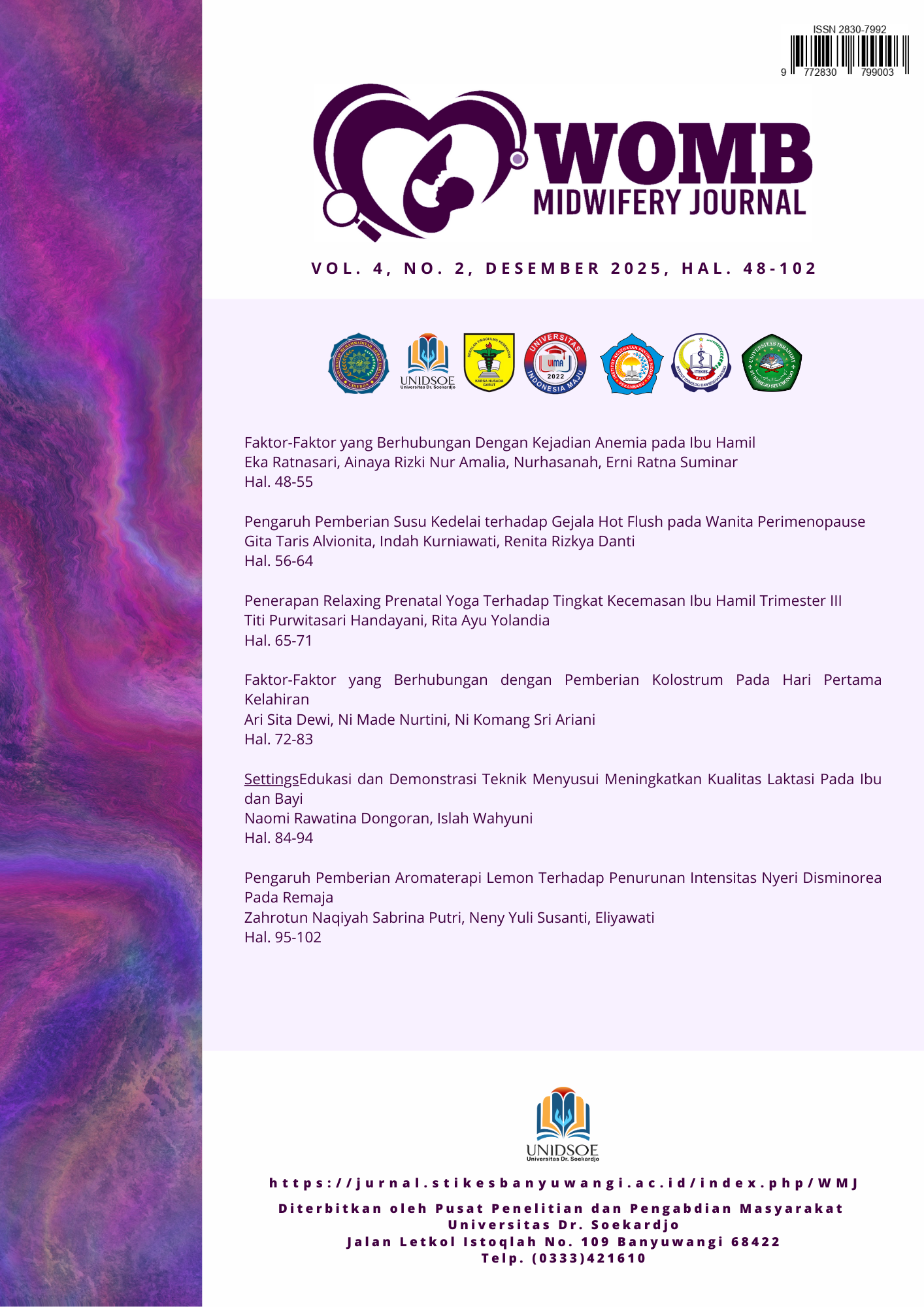
Edukasi dan Demonstrasi Teknik Menyusui Meningkatkan Kualitas Laktasi Pada Ibu dan Bayi
DOI:
https://doi.org/10.54832/wombmidj.v4i2.708Keywords:
Continuous care, Education, Breastfeeding techniques, LactationAbstract
Proper breastfeeding is an essential physiological practice for the health of mothers and babies, especially in the early stages of life. However, successful breastfeeding is not only determined by timing, but also by the mother's knowledge, experience, and skills in applying proper breastfeeding techniques. This study aims to describe continuous midwifery care for Mrs. S through the application of breastfeeding techniques from pregnancy to the postpartum period as a lactation preparation effort. The uniqueness of this study lies in the application of education and demonstration of breastfeeding techniques continuously across midwifery service periods and objective evaluation using several assessment instruments. The care was provided in Simataniari Village, Hasundutan District, North Sumatra, in 2025, covering the final trimester of pregnancy, childbirth, postpartum, newborn, neonate, and family planning services. The results showed a significant increase in mothers' knowledge (score of 10 to 16), breastfeeding self-efficacy based on BSES-SF (score of 36 to 59), breastfeeding skills based on LATCH scores (score of 6 to 10), and understanding of breastfeeding techniques (score of 23 to 39). No complications such as sore nipples or breast engorgement were found during the lactation process. These findings indicate that support combined with education and demonstrations of breastfeeding techniques is effective in supporting a comfortable, safe, and sustainable lactation process. The application of this method is recommended as a strategy to increase breastfeeding success in midwifery services.
References
Almini P, Omani-Samani R, Sepidarkish M, Almasi-Hashiani A, Hosseini M, Maroufizadeh S. The Breastfeeding Self-Efficacy Scale–Short Form (BSES-SF): a validation study in Iranian mothers. BMC Res Notes. 2019;12(1):1–6. doi:10.1186/s13104-019-4656-7.
Anggraeni L, Fatharani W, Lubis DR. Hubungan tingkat pengetahuan ibu menyusui dengan teknik pemberian ASI secara eksklusif. J Educ Dev. 2023;11(2):129–133. doi:10.37081/ed.v11i2.4469.
Çeltindemir EO, Cangöl E. The effect of breastfeeding education given through the teach-back method on mothers’ breastfeeding self-efficacy and breastfeeding success: a randomized controlled study. BMC Pregnancy Childbirth. 2024;24(1):1–12. doi:10.1186/s12884-024-06601-0.
Cheng GZ, Chen A, Xin Y, Ni QQ. Using the teach-back method to improve postpartum maternal–infant health among women with limited maternal health literacy: a randomized controlled study. BMC Pregnancy Childbirth. 2023;23(1):1–14. doi:10.1186/s12884-022-05302-w.
Dewi Susilawati, Nikelsuma NF, Syahid A. Development of midwifery documentation system in web-based pregnancy care. Window Health J. 2025;8(2):179–191. doi:10.33096/woh.v8i2.1332.
Emilda ALS EA, Fazdria F, Dewi S. Hubungan peran konselor laktasi dalam konseling menyusui terhadap keberhasilan ibu memberikan ASI eksklusif. Feminal J Ilm Kebidanan. 2023;3(2):223–230. doi:10.30867/feminal.v3i2.481.
Fikre R, Gubbels J, Teklesilasie W, Gerards S. Effectiveness of midwifery-led care on pregnancy outcomes in low- and middle-income countries: a systematic review and meta-analysis. BMC Pregnancy Childbirth. 2023;23(1):1–11. doi:10.1186/s12884-023-05664-9.
Foranci Y, Nontji W, Arifuddin S. Pengaruh model continuity of care dalam asuhan kehamilan dan persalinan terhadap luaran bayi baru lahir. J TeleNurs (JOTING). 2023;5(2):3589–3597. doi:10.31539/joting.v5i2.7470.
Hallgar K, Mangshetthy RB, B AA. LATCH score: a tool for identification and correction of breastfeeding problems in a tertiary care hospital of North Karnataka. Int J Contemp Pediatr. 2024;11(3):272–276. doi:10.18203/2349-3291.ijcp20240343.
Handayani I, Supliyani E. Dukungan bidan dalam meningkatkan breastfeeding self-efficacy masa awal laktasi. J Ris Kes Poltekkes Depkes Bandung. 2021;13(1):152–159. doi:10.34011/juriskesbdg.v13i1.1871.
Junengsih J, Syarifah R, Kusumastuti A, Herlyssa H, Wahyuni ED, Fatimah YU, et al. The effect of continuity of midwifery care (CoMC) based on EDULACTIN application and booklet on postpartum fitness quality. Amerta Nutr. 2024;8(2SP):41–48. doi:10.20473/amnt.v8i2SP.2024.41-48.
Kementerian Kesehatan Republik Indonesia. Profil Kesehatan Indonesia Tahun 2023. Jakarta: Kemenkes RI; 2023.
Marks KJ, Gosdin L, O’Connor LE, Hamner HC, Grossniklaus DA. Changes in maternity care policies and practices that support breastfeeding as measured by the Ten Steps to Successful Breastfeeding—United States, 2018–2022. BMC Pregnancy Childbirth. 2024;24(1):1–9. doi:10.1186/s12884-024-06672-z.
McFadden A, Siebelt L, Marshall JL, Gavine A, Girard LC, Symon A, et al. Counselling interventions to enable women to initiate and continue breastfeeding: a systematic review and meta-analysis. Int Breastfeed J. 2019;14(1):1–19. doi:10.1186/s13006-019-0235-8.
Nurhidayah A. Efektivitas teknik pemberian ASI dengan metode LATCH terhadap kemampuan menyusui pada ibu postpartum. Preventif J Kes Masy. 2023;14(2):1–12. doi:10.22487/preventif.v14i2.742.
Rahmawati Y, Windayanti H, Suroso I, Azizah A, Fitriana Sakti T. Literatur review: peran ibu dalam keberhasilan pemberian ASI eksklusif. J Univ Ngudi Waluyo. 2024;3(1):599–606.
Sulistyani MD, Roslina R, Sudarmi S, Sulistianingrum L. Breastfeeding self-efficacy dan keberhasilan pemberian ASI eksklusif di Kota Bandar Lampung. Preventif J Kes Masy. 2023;14(3):473–482. doi:10.22487/preventif.v14i3.955.
Sundari SM, Al AA, Sirajuddin S, Nilawati Usman A. Effect of continuity of care to exclusive breastfeeding mothers’ compliance in regional community health centre in Makassar City, South Sulawesi. Int J Sci Basic Appl Res. 2018;39(1):114–120.
yahri IM, Laksono AD, Fitria M, Rohmah N, Masrulroh M, Ipal M. Exclusive breastfeeding among Indonesian working mothers: does early initiation of breastfeeding matter? BMC Public Health. 2024;24(1):1–10. doi:10.1186/s12889-024-18619-2.
World Health Organization, UNICEF. Protecting, promoting and supporting breastfeeding in facilities providing maternity and newborn services: implementing the revised Baby-Friendly Hospital Initiative 2018. Geneva: WHO; 2018.
World Health Organization, UNICEF. The baby-friendly hospital initiative for small, sick and preterm newborns. Geneva: WHO; 2020.
Yen PH, Leasure AR. Use and effectiveness of the teach-back method in patient education and health outcomes. Fed Pract. 2019;36(6):284–289
Downloads
Published
Issue
Section
License

This work is licensed under a Creative Commons Attribution-ShareAlike 4.0 International License.
This work is licensed under a Creative Commons Attribution-ShareAlike 4.0 International License